Destinations
Marrakech: The Red City of Morocco
By Morocco Explorers
8 min read
Marrakech for first-timers: what to see, when to go, what to eat, and how to plan a 3–4 day visit with day trips to the Atlas Mountains.

Marrakech is the red city of Morocco: a thousand-year-old medina of souks, palaces and gardens, framed by the snow-capped High Atlas and the stone desert of Agafay. Allow 3 to 4 days — enough for Jemaa el-Fnaa, the palaces and gardens, and one day trip into the mountains. The best time to visit is March to May or October to November, when days are warm, evenings are cool and the light is at its best.
This guide covers what to see, what to eat, where to stay, how to get around and when to go — written by the local team at Morocco Explorers who run tours here every week.
Few cities compress so much of Morocco into a walkable space. Inside the 12-kilometre ochre walls you find a UNESCO-listed medina, a 12th-century minaret, tiled palaces, a 19th-century garden by Yves Saint Laurent, and street food that starts at sunset. Outside them, the High Atlas is under 90 minutes away and the Agafay desert is closer still.
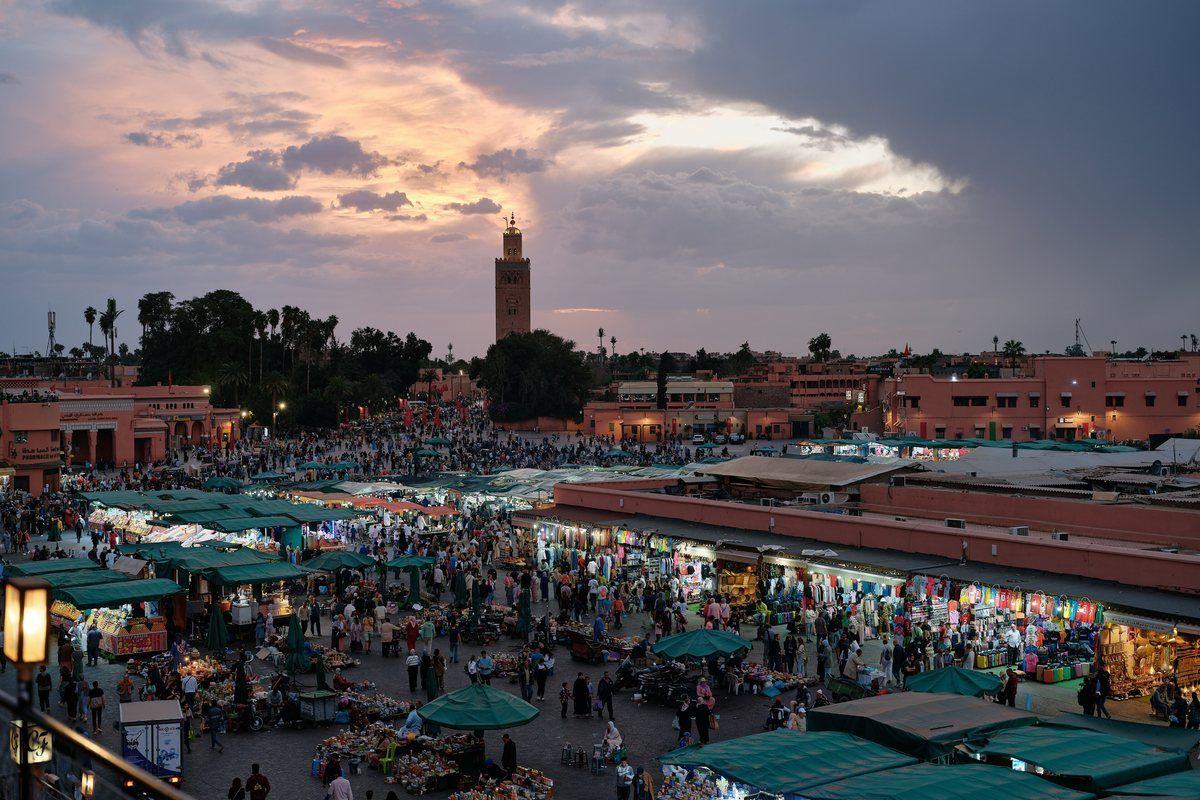
The main square is the heart of the city and a UNESCO Intangible Cultural Heritage site. By day it is juice stalls, snake charmers and carriage rides; after sunset it becomes dozens of open-air kitchens. Eat where the locals queue and agree prices before you order. Read our full Jemaa el-Fnaa guide.
The 77-metre minaret is Marrakech's landmark and the model for Seville's Giralda. Non-Muslims cannot enter, but the gardens and the view from the surrounding square at sunset are free and unmissable. More in our Koutoubia guide.
Built in the late 19th century for the grand vizier Ba Ahmed, Bahia is a maze of courtyards, cedar ceilings and zellige. Visit early to avoid the crowds and the midday heat. See our Bahia Palace guide.
The Saadian Tombs, sealed for centuries and rediscovered in 1917, hold the finest carved marble in the city. The Ben Youssef Madrasa, founded in the 14th century and rebuilt in the 16th, is the largest Quranic school in Morocco — its courtyard is the single most photographed interior in Marrakech.
The cobalt-blue Jardin Majorelle was designed by painter Jacques Majorelle and later owned by Yves Saint Laurent; book tickets online in advance. The Menara Gardens, laid out in the 12th century, are the quietest place in the city at sunset. Our Jardin Majorelle guide has the details.
Semmarine and the surrounding souks sell everything from babouches to lanterns. Haggling is expected: start around half the asking price, stay friendly, and walk away if the deal does not feel right. Our souk guide explains what to buy and what to pay.
Vegetarians are well served: zaalouk, taktouka, bissara and vegetable tagines are on every menu. Alcohol is available in licensed riads and hotels, but not in the medina's traditional restaurants.
| Season | Typical daytime | What to expect |
|---|---|---|
| March–May | 22–28°C | Best overall: warm days, cool evenings, gardens in bloom |
| June–August | 32–38°C | Very hot; sightsee early and late, pool in the afternoon |
| September–November | 24–30°C | Excellent: warm sea of light, harvest season in the Atlas |
| December–February | 18–20°C | Mild days, cold nights (5–8°C); snow on the Atlas peaks |
Ramadan changes the rhythm of the city: many restaurants close by day and reopen for iftar. It is a fascinating time to visit — just plan dinners later than usual.
For a first visit, stay in the medina or within walking distance of Jemaa el-Fnaa. Book riads directly with a licensed operator when possible — it makes transfers, tours and dietary needs much easier.
Marrakech Menara Airport (RAK) is about 6 kilometres from the medina — 15–20 minutes by car. Use a metered petit taxi (ask the driver to use the meter), a pre-booked transfer or the airport bus. Inside the medina, everything is walkable; outside it, petits taxis are cheap. Agree the price or insist on the meter before you get in, and carry small notes.
We are a local Moroccan agency based in Marrakech. We organise airport transfers, riad bookings, private guides and small-group day trips — including the Atlas, Ourika, Essaouira and the Sahara. Browse our Morocco tours or start from our Marrakech destination guide, and we will build an itinerary around your dates.
Give the medina at least two days. Start in the souks before the heat, break for mint tea, and return to Jemaa el-Fnaa at sunset. A licensed guide is worth it for a first visit.
Yes. Marrakech packs a UNESCO-listed medina, palaces, gardens, a legendary food scene and the Atlas Mountains into a compact, walkable city — one of the most rewarding first stops in Morocco.
Three to four days is ideal. Two days cover the medina, Jemaa el-Fnaa, Bahia Palace and Jardin Majorelle; add one or two more for day trips to the Atlas Mountains, Agafay desert or Essaouira.
March to May and October to November offer the best weather, with warm days of 22–30°C. July and August are very hot (32–38°C), while winter days are mild at 18–20°C but nights are cold.
Marrakech is generally safe for visitors. As in any busy tourist city, guard against pickpocketing in the souks and Jemaa el-Fnaa, ignore unsolicited 'guides', and use licensed taxis or pre-booked transfers.
Wear light, comfortable and modest clothing: shoulders and knees covered in the medina and inside religious sites, plus a scarf for women if you plan to visit mosques. Comfortable shoes matter on the medina's uneven lanes.
Try tanjia (slow-cooked beef), lamb tagine with prunes, Friday couscous, msemen pancakes, bissara soup and fresh orange juice in Jemaa el-Fnaa. Vegetarian tagines and salads such as zaalouk are available everywhere.
Marrakech Menara Airport (RAK) is about 6 km from the medina, a 15–20 minute drive. Take a metered petit taxi, the airport bus, or a pre-booked private transfer — the easiest option with luggage and a riad in the pedestrian medina.
French and Moroccan Arabic (Darija) are the everyday languages, with Amazigh widely spoken. English is common in hotels, riads, tour agencies and restaurants in the tourist areas, but learning a few Arabic greetings goes a long way.
Hero photo: Herokk · CC BY-SA 4.0 · Wikimedia Commons