Highlights
Koutoubia Mosque: Iconic Minaret
By Morocco Explorers
7 min read
Koutoubia guide: Marrakech's 12th-century Almohad minaret, its 77-metre tower and four globes, what visitors can see, the best light and the legends around it.

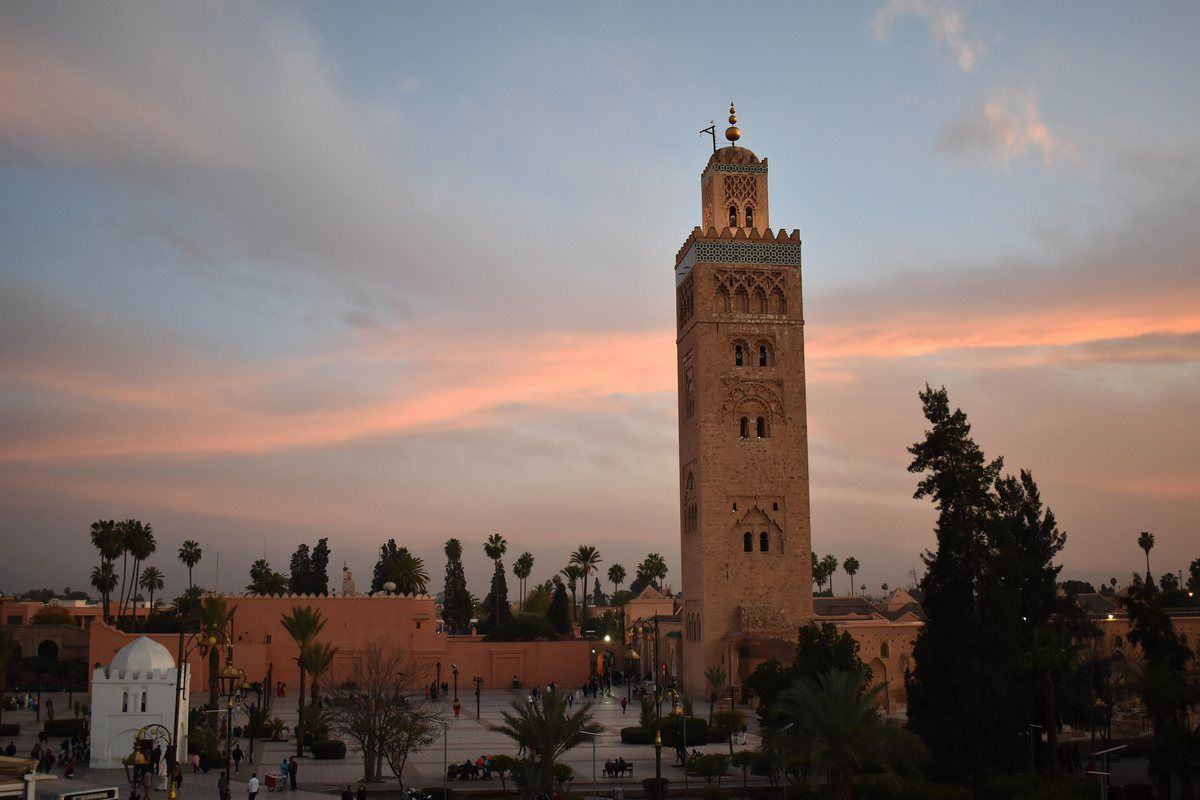
The Koutoubia is Marrakech's landmark: an Almohad minaret from the 12th century rising about 77 metres above the medina, visible from almost everywhere and the model for Seville's Giralda. Non-Muslims cannot enter the mosque, but the gardens and the view are open to everyone — and the hour around sunset is the best time to be here. The square of Jemaa el-Fnaa is right beside it.
This guide explains the history, what you can and cannot see, and the legends of the tower — written by the local team at Morocco Explorers.
The Koutoubia is the largest mosque in Marrakech and one of the masterpieces of Almohad architecture. Its name comes from the Arabic for booksellers — kutubiyyin — because the book market once clustered at its base. For centuries its tower has been the city's compass: from the souks to the rail station, people navigate by the minaret. It is also the architectural parent of Seville's Giralda and Rabat's Hassan Tower, all built by the same Almohad tradition, which is why visitors from Spain often find it strangely familiar.
The first mosque here was begun by the Almohads after they took Marrakech in 1147; the present building and its minaret were completed under Caliph Yaqub al-Mansur at the end of the 12th century. The minaret rises through several bands of decoration to a lantern topped with four globes — three of copper and one of gold, according to tradition. The legend says the golden globe was made from the jewellery of the caliph's wife, melted as penance after she broke the Ramadan fast; historians prefer more prosaic explanations, but every guide in Marrakech will tell you the story.
The mosque interior is reserved for Muslims and prayer; visitors explore the gardens and the plaza around the base, where the stonework is best seen up close. The gardens are a good place to rest, read and watch the light move across the tower.
Stand at the base and look up: the tower is not a simple square but a sequence of carved fields, arrow-slit windows and interlaced arches. The decorative bands repeat on all four sides, and the top is crowned by the lantern and globes.
Sunset is the classic hour: from the edge of Jemaa el-Fnaa, from the gardens, or from a rooftop café terrace, the tower turns gold and the calls to prayer echo across the city. Morning light is cleaner for photographs without crowds.
After dark the minaret is floodlit, and the contrast with the lamps of the square below is one of the images of Marrakech. See our square guide for the evening rituals.
The whole medina around the Koutoubia is a UNESCO World Heritage Site — the Medina of Marrakesh. For the full picture, start from our Marrakech guide.
| Season | Weather | Notes |
|---|---|---|
| March–May | 22–28°C | Gardens at their best, pleasant walks around the medina |
| June–August | 32–38°C | Go early or at sunset; the gardens give little shade at noon |
| September–November | 24–30°C | Excellent: warm evenings and clear sunset light |
| December–February | 18–20°C | Quiet, cool and crisp; the minaret stands out in winter light |
Ramadan evenings around the Koutoubia are especially atmospheric, with the square filling for iftar after the sunset call.
We are a local agency: guided walks that begin at the Koutoubia, food evenings on the square and trips beyond the city. Book a guided medina walk, or browse all Morocco tours — and tell us your dates.
The Koutoubia is best seen from the outside and the gardens. Walk around at sunset, then continue into the medina for dinner.
Non-Muslims cannot enter the mosque or its prayer hall, but the gardens and the plaza around it are open to everyone, and the exterior of the minaret is the main sight.
About 77 metres, making it the tallest structure in Marrakech and the model for Seville's Giralda and Rabat's Hassan Tower, built by the same Almohad tradition.
Tradition says the tower carries four globes — three copper and one gold. The legend attributes the golden globe to the jewellery of the caliph's wife, melted as penance; historians offer less romantic explanations.
Sunset, when the tower turns gold above Jemaa el-Fnaa and the calls to prayer fill the city. Early morning is best for clean photographs without crowds, and the floodlit minaret is beautiful at night.
Thirty to forty-five minutes for the gardens and the exterior of the mosque, longer if you stay for the sunset light and the life of the square around it.
At the edge of the medina beside Jemaa el-Fnaa, about ten minutes on foot from the main souk entrances, with the Kasbah and Bahia Palace further south through the medina.
From the Arabic kutubiyyin, the booksellers who once traded at the base of the mosque — the book market gave the tower its name.
Yes, from the gardens and the square, and it appears in almost every Marrakech skyline photo. Avoid photographing worshippers at prayer, and dress modestly around the entrances.
Hero photo: Misa.stefanovic.07 · CC BY-SA 4.0 · Wikimedia Commons