Highlights
Bou Inania Madrasa: Masterpiece
By Morocco Explorers
7 min read
Bou Inania Madrasa guide: the 14th-century Marinid masterpiece of Fes, its courtyard, cedar and stucco, the water clock opposite, and how to visit it well.

The Bou Inania Madrasa is the finest building in the Fes medina: a 14th-century Marinid college built by Sultan Abu Inan between 1350 and 1355, where cedar, stucco, marble and zellige are worked with a precision that still amazes craftsmen today. Unlike most madrasas it is also a mosque, with its own minaret and Friday prayers. It sits between Bab Boujloud and the souks, and 30 to 45 minutes is enough to see it — but you will want longer.
This guide covers the history and the details not to miss — written by the local team at Morocco Explorers.
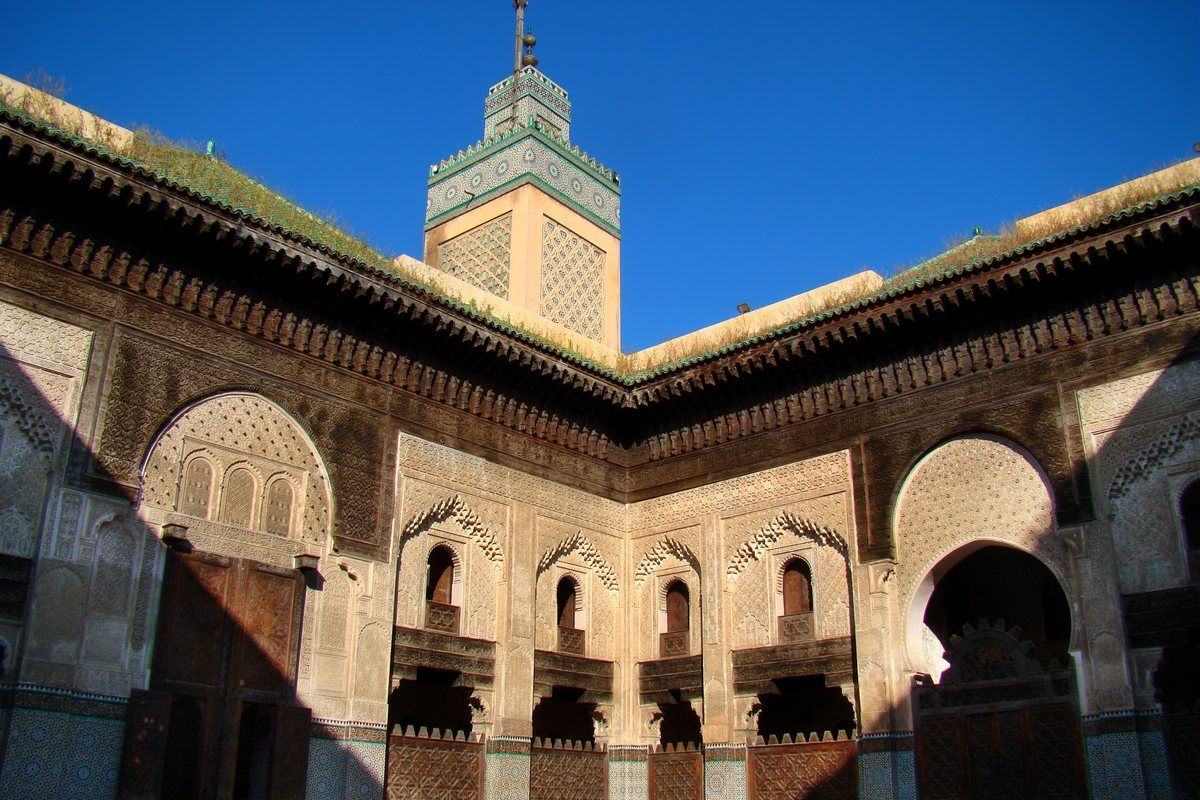
Fes has many madrasas; Bou Inania is the one that shows what Marinid architecture could do when money and ambition met. The street door gives no hint: step through and the medina disappears, replaced by a courtyard of light, carved plaster, green and blue zellige and a fountain under a cedar dome. It is small, perfectly proportioned and still used as a place of prayer — one of the most beautiful rooms in Morocco.
Abu Inan Faris, a Marinid sultan, founded the madrasa between 1350 and 1355 as a college for the study of law and religion, with living cells for students and an endowment to feed and pay them. Like the other great madrasas of the era, it was a statement of piety and power: the sultan's name appears throughout the decoration. It is the near-twin of the Bou Inania he built in Meknes — see our Meknes guide for that one — and it remains both an active mosque and the most visited monument of the medina.
You enter through a corridor that turns twice — a classic device to separate the noise of the medina from the silence of the courtyard. Watch the cedar doors and the carved panels as you pass.
The heart of the building: a marble floor, a central fountain, walls of zellige and stucco, and above them carved cedar and the green-tiled roofs. The proportions are perfect and the light changes hour by hour.
The prayer hall opens off the courtyard with a carved cedar screen; above and around, the student cells climb the walls, tiny rooms that show how spartan the scholars' lives were compared with the decoration below.
The minaret marks the madrasa as a mosque. Opposite, across Talaa Kebira, the Dar al-Magana once told the hours with a system of weights fed by water — a 14th-century clock in a beautiful facade, restored but no longer running. Look for it on your way out.
The madrasa stands inside Fes el-Bali, a UNESCO World Heritage Site — the Medina of Fes.
| Season | Weather | Notes |
|---|---|---|
| March–May | 17–26°C | Ideal: comfortable walking and clear courtyard light |
| June–August | 30–38°C | Visit at opening; the interior is cool but the lanes are hot |
| September–November | 20–30°C | Excellent: warm days, fresh mornings, low-angle light |
| December–February | 10–18°C | Quiet and cool; the carved details read beautifully in winter light |
Ramadan brings a special atmosphere, with the madrasa busy around prayer times; check visiting hours accordingly.
Our licensed guides run medina walks that include the madrasas, the souks and the tanneries, with the stories behind every panel. Book an imperial cities tour from Fes or browse all Morocco tours — and tell us your dates.
Bou Inania is a quiet masterpiece. Visit outside prayer times, look at the carved cedar and zellij, and keep your voice low.
Yes — it is the finest building in the Fes medina and the peak of Marinid craft, small, perfectly proportioned and still an active mosque. Thirty to forty-five minutes is enough, and it sits beside Bab Boujloud.
The Marinid sultan Abu Inan Faris, between 1350 and 1355, as a college for law and religion with student cells and an endowment — and as a statement of Marinid piety and power.
It is the only madrasa in Morocco with its own minaret and Friday prayers, making it both college and congregational mosque, and its decoration is considered the finest of the Marinid period.
The Dar al-Magana, a 14th-century hydraulic clock house across Talaa Kebira that once marked the hours with weights and water. It has been restored but no longer runs; look for it as you leave.
Yes — this madrasa is open to visitors of all faiths outside prayer times, unlike the great mosques. Dress modestly, keep voices low and respect worshippers.
Thirty to forty-five minutes for the courtyard, prayer hall and cells; an hour if you linger over the carving and the displays. Early morning is quietest.
In the Fes medina, a few steps from Bab Boujloud on Talaa Kebira — the main route into the souks — and within walking distance of Al Quaraouiyine and the tanneries.
Modest clothing with shoulders and knees covered, socks and shoes that are easy to remove, and respect for prayer times. A scarf is useful for sun or dust in the lanes.
Hero photo: Bjørn Christian Tørrissen · CC BY-SA 3.0 · Wikimedia Commons