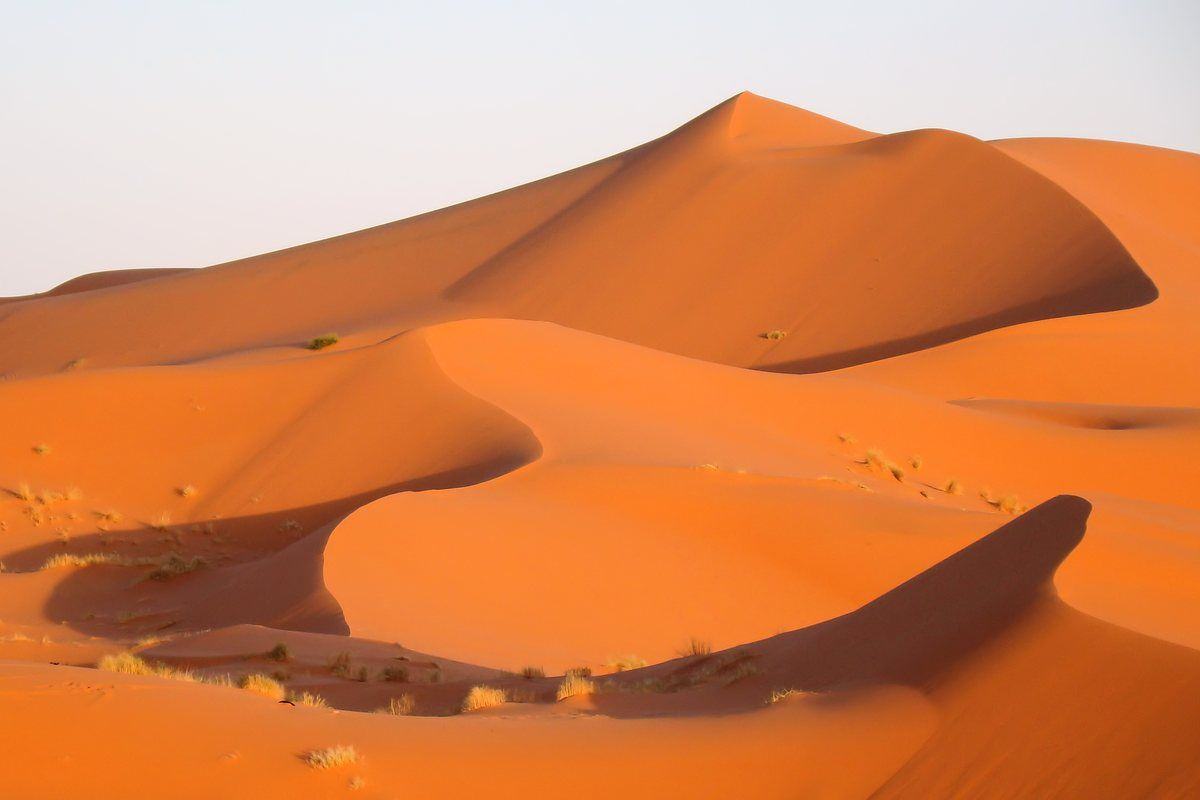
Morocco's Sahara is the sea of orange dunes at Erg Chebbi, next to the village of Merzouga. You sleep in a Berber camp, ride a camel to watch the sun set over dunes that rise up to about 150 metres, and eat dinner around a fire under one of the darkest skies in North Africa. It takes three days from Marrakech or two days from Fes, and the best months are October to April.
This guide explains where to go, how to get there, what a desert tour actually involves and how to choose a camp — written by the local team at Morocco Explorers who run desert tours every week.
Why the Moroccan Sahara is worth it
Erg Chebbi is a 28-kilometre band of dunes on the edge of the Drâa-Tafilalet region — the classic image of the Sahara, yet reachable by road in one long day from Marrakech. The desert here is not only sand: you cross the High Atlas at Tizi n'Tichka (2,260 m), palm oases, the Dades and Todra gorges and the adobe ksar of Aït Benhaddou.
- The dunes — 150-metre ridges that change colour from honey to deep orange through the day.
- The night sky — minimal light pollution makes Merzouga one of Morocco's best stargazing spots.
- Berber culture — Amazigh villages, Gnawa music in Khamlia and mint tea in a nomad tent.
- The route — Aït Benhaddou (UNESCO World Heritage), Ouarzazate film studios, Todra Gorge and fossil towns.
Where to go in the Moroccan Sahara
| Desert | Access | Best for |
|---|
| Erg Chebbi (Merzouga) | 3 days from Marrakech, 2 from Fes; hotels and camps at the dune edge | Classic dune experience, easiest logistics, camel treks and luxury camps |
| Erg Chigaga (M'Hamid) | 4x4 only from M'Hamid; remote | True off-grid silence, large wild dunes, no crowds |
| Zagora / Drâa Valley | 2 days from Marrakech | Shorter trips, palm oases and kasbahs, smaller dunes |
For a first desert trip, Erg Chebbi is the best balance: real dunes, comfortable camps and a manageable drive. See our Erg Chebbi guide and, for the more remote option, our notes on Zagora and the Drâa Valley.
Getting there: Marrakech or Fes
From Marrakech (3 days, 2 nights) — the classic loop crosses the High Atlas and Aït Benhaddou, stays in the Dades Valley or Todra Gorge, reaches Merzouga on day two for the camel trek and camp, then returns on day three. Longer versions add Ouarzazate or the Drâa Valley.
From Fes (2 days, 1 night) — the shorter route goes through the Middle Atlas, Azrou's cedar forest and the Ziz Valley to Merzouga. It is the most popular add-on to a northern Morocco itinerary.
Distances are real: Marrakech to Merzouga is about 560 km, most of it mountain and desert road. A private 4x4 or minivan with a driver-guide is the comfortable option; small-group tours cost less but move at the group's pace. Browse our 3-day Merzouga tour from Marrakech and 4-day version, or read the Atlas Mountains guide for the crossing.
What you actually do in the desert
- Camel trek — one to two hours from Merzouga to the camp, timed for sunset; a guide leads the animals on foot.
- Desert camp night — tagine dinner, drums and Gnawa songs around the fire, then silence and stars.
- Sandboarding and 4x4 — board down the dunes, or take a 4x4 deeper into Erg Chebbi.
- Sunrise on the dunes — the reason to wake early; the light is best in the first hour.
- Culture stops — Khamlia's Gnawa musicians, Rissani's market, Erfoud fossil workshops and the Ouarzazate film studios.
Read more about the dunes themselves in our Merzouga dune experience guide.
When to go: desert weather by season
| Season | Days | Nights | Notes |
|---|
| October–November | 25–30°C | 12–17°C | Best overall: warm days, cool nights, clear skies |
| December–February | 17–22°C | 2–8°C | Mild days but genuinely cold nights — take layers |
| March–April | 24–30°C | 10–15°C | Excellent; occasional spring sandstorms |
| May–September | 35–42°C+ | 20–28°C | Very hot; if you go, choose sunrise and sunset activities |
Ramadan and the summer months are quiet and cheap but genuinely hot. If you travel in July or August, pick a camp with a pool and keep daytime activity to a minimum.
Standard camp or luxury camp?
Standard camps use shared or simple private tents with basic beds and shared bathrooms; they are cheap and authentic. Luxury camps offer private tents with proper beds, en-suite bathrooms, hot water and better food — still under canvas, at two to four times the price. Both include dinner, breakfast and the camel trek. In winter, ask specifically about blankets and heating; in summer, about fans and shade.
You can also sleep in a guesthouse in Merzouga village and visit the dunes by 4x4, which suits families with small children or anyone who prefers a real bed.
What to pack for the desert
- Layers — T-shirt by day, fleece and windproof jacket at night, even in spring.
- Shoes — closed trainers or sandals; dunes are walked barefoot, but the camp ground is stony.
- Essentials — head torch, scarf for wind and sun, sunglasses, hat, sunscreen, lip balm.
- Water — at least two litres per person per day; camps provide dinner drinks but not unlimited water.
- Power — a power bank; charging points are limited in standard camps.
Safety and responsible travel
- Book through a licensed operator; do not try to drive into the dunes yourself.
- In summer, avoid midday sun and drink more water than feels necessary.
- Take your rubbish back to Merzouga — desert waste is a growing problem.
- Ask before photographing people; a small tip is normal for camel guides and musicians.
- Support local: camps and guides that employ Amazigh families keep tourism money in the region.
Plan your Sahara trip with Morocco Explorers
We run private and small-group desert tours from Marrakech, Fes and Ouarzazate, with licensed driver-guides, comfortable 4x4s and camps we know personally. Start with our Sahara destination guide or see all Morocco tours, and tell us your dates — we will build the route around them.
Trip notes
Plan two nights if possible: one in Merzouga and one in the dunes. Choose a camp with proper beds, confirm the pickup point, and pack layers for cold nights.
- Book a small group rather than a packed convoy.
- Avoid summer midday heat.
- Bring a headlamp and refillable water bottle.