Destinations
Rabat: Morocco's Royal Capital
By Morocco Explorers
7 min read
Rabat travel guide: the Kasbah of the Udayas, Hassan Tower and the Mausoleum of Mohammed V, the Chellah, the medina and why the capital is worth a day.

Rabat is Morocco's capital and its calmest imperial city: a UNESCO-listed ensemble of a 12th-century kasbah, an unfinished Almohad minaret, the marble mausoleum of Mohammed V and a French-designed modern centre, all beside the Atlantic and the Bou Regreg river. Unlike Marrakech or Fes, it is a working government city — which is exactly why it feels unhurried and authentic. One full day covers it; two days let you add Salé and the beach.
This guide covers the sights and logistics — written by the local team at Morocco Explorers.
Rabat was made a UNESCO World Heritage site in 2012 as "Modern Capital and Historic City: a Shared Heritage", recognising how the Almohad, Andalusian and 20th-century French layers combine into one city. The result is a capital you can cross on foot and by tram, with fewer crowds than anywhere else of comparable importance.
Climb through the massive Almohad gate into lanes of blue and white houses, the old mosque, and terraces over the Atlantic. The Andalusian Gardens, planted in the 20th century, are free and serene; the café at the top has the best view over the Bou Regreg to Salé.
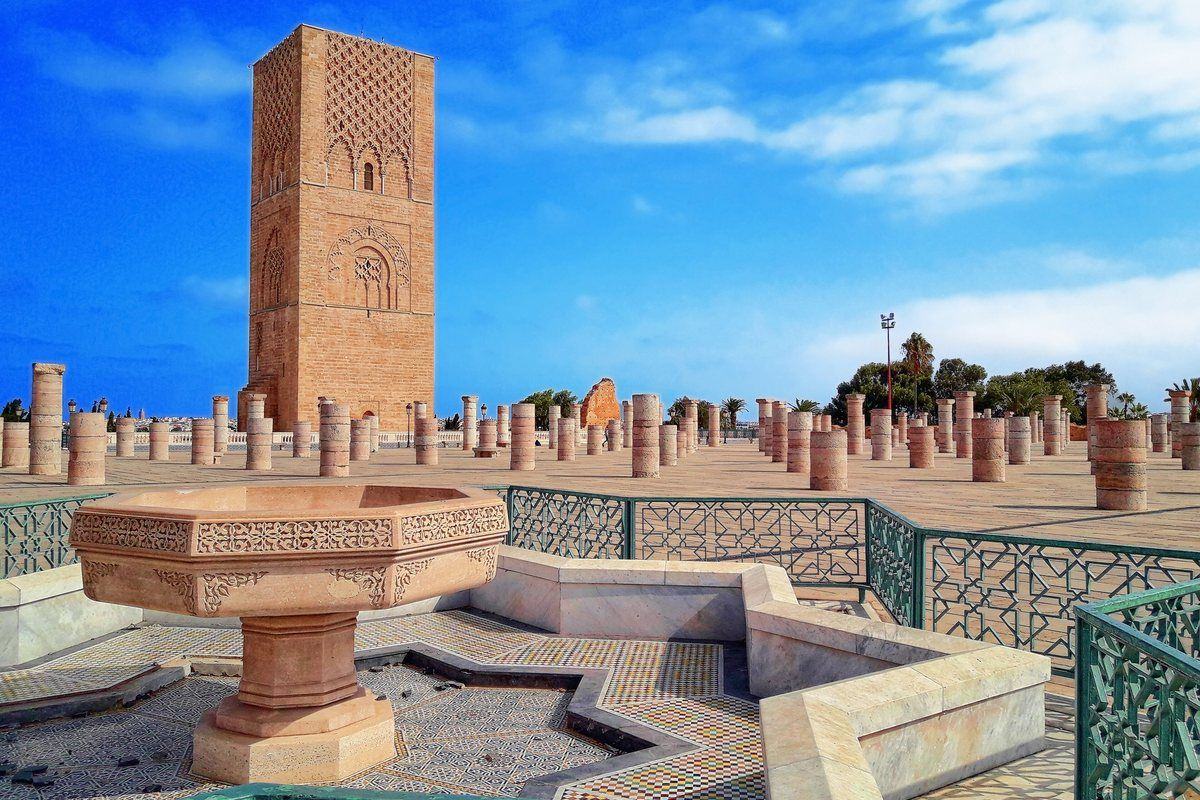
The Hassan Tower, begun in 1195, was meant to be the minaret of an enormous mosque; only the tower and columns remain. Opposite, the Mausoleum of Mohammed V holds the tombs of the king, Hassan II and Prince Moulay Abdellah under carved marble and a golden roof, guarded by Royal Guards in white and red. Non-Muslims may visit the mausoleum's gallery.
Just outside the walls, the Chellah combines the Roman city of Sala Colonia with a 14th-century Marinid necropolis: ruins, towers, an orchard and a colony of storks. Recently restored, it is the most atmospheric site in Rabat.
Rabat's medina is small and genuine — rue des Consuls for carpets, Souika for everyday life. In the new town, the Art Deco facades along Avenue Mohammed V and the market at Bab el Had show the protectorate's urban planning.
The old pirate republic of Salé, connected by tram and the new marina, has its own medina, the Bab Mrisa gate and the Great Mosque. It is the quieter half of the capital.
| Season | Weather | Notes |
|---|---|---|
| March–May | 17–23°C | Best overall: gardens in bloom, comfortable walking |
| June–August | 22–28°C | Warm and breezy; beaches at Salé and Skhirat are busy |
| September–November | 19–26°C | Excellent light and fewer visitors |
| December–February | 12–17°C | Mild and rainy; museums and cafés come into their own |
Rabat sits perfectly between Casablanca and Tangier: see our 7-day Imperial Cities tour and all Morocco tours, or read the Casablanca guide for the next stop.
Rabat is calm and walkable. Pair the Hassan Tower with the Kasbah of the Udayas, then finish at the Chellah.
Yes. Rabat combines the blue Kasbah of the Udayas, Hassan Tower, the royal mausoleum and the Roman-Marinid Chellah in a relaxed, walkable capital — a strong contrast to Marrakech and Fes and an easy stop between Casablanca and Tangier.
One full day covers the Kasbah of the Udayas, Hassan Tower, the Mausoleum of Mohammed V and the Chellah. Add a second day for the medina, the museums and Salé across the river.
Yes, non-Muslims may enter the gallery around the tombs and see the royal guards, provided shoulders and knees are covered. It is one of the few royal religious sites open to all visitors.
The Chellah is a walled site outside Rabat's walls that combines the Roman city of Sala Colonia with a 14th-century Marinid necropolis. Recently restored, it has ruins, gardens and a large stork colony.
The Al Boraq high-speed train takes about 50 minutes from Casablanca and 1h20 from Tangier. Regular trains also connect Fes, Meknes and Marrakech; Rabat-Salé Airport (RBA) has limited flights.
March to May and September to November, with mild temperatures of 17–26°C. Summer is warm and breezy, winter is mild and rainy, and the city stays comfortable year-round thanks to the Atlantic.
Yes — Casablanca is 50 minutes by train, Salé is 10 minutes by tram, and Meknes 2 hours. Rabat also pairs naturally with Casablanca on a one- or two-day circuit.
Rabat is one of the safest and calmest Moroccan cities. Use the usual precautions in the medina and around the stations, keep bags zipped, and expect a quiet, orderly atmosphere, especially in the government districts.
Hero photo: OHamama · CC BY-SA 4.0 · Wikimedia Commons